Codon Chart: Life continues from one generation to the next as a result of replication, transcription, and translation of the genetic code stored in DNA and RNA.
The genetic code contains the sequence of nucleotide bases within DNA and RNA:
– DNA consists of four nucleotide bases: adenine (A), guanine (G), cytosine (C), and thymine (T).
– The genetic code in DNA is transcribed into RNA, which serves as a template for protein synthesis.
– RNA consists of the bases adenine (A), guanine (G), cytosine (C), and uracil (U).
These nucleotide sequences code for amino acids that link together to form proteins. The genetic code acts as a set of instructions that assembles amino acids in the correct order to form proteins.
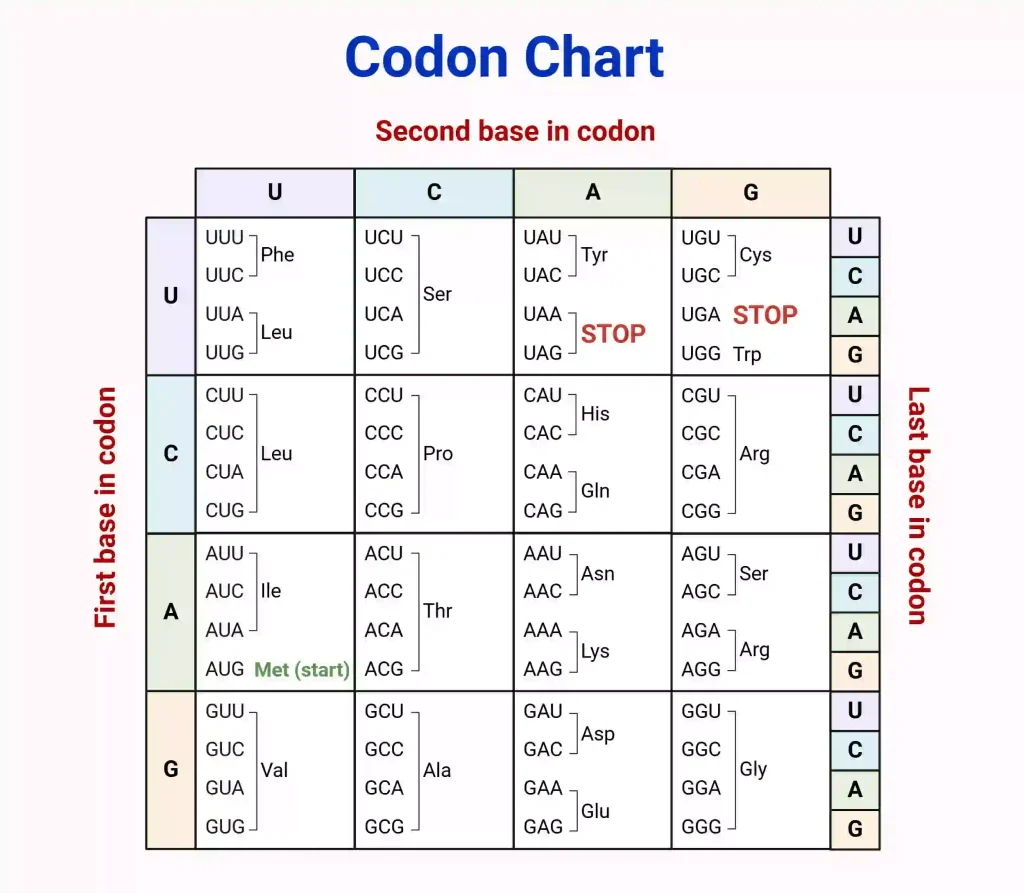
The genetic code is read in sets of three nucleotides, known as codons. Each codon specifies a particular amino acid or serves as a signal to start or stop protein synthesis.
The first codon was discovered during Marshall Nirenberg and J. Heinrich Matthaei’s poly-U experiment, which revealed that a sequence of three uracil units (UUU) in RNA codes for the amino acid phenylalanine. Nirenberg and his team subsequently identified all 64 codons and their corresponding amino acids. For their work in deciphering the genetic code, Nirenberg, Robert W. Holley, and Har Gobind Khorana were jointly awarded the Nobel Prize in Physiology or Medicine in 1968.
What is a Codon Chart?
A codon chart or table is used as a reference tool that correlates specific codons with the corresponding amino acids they encode.
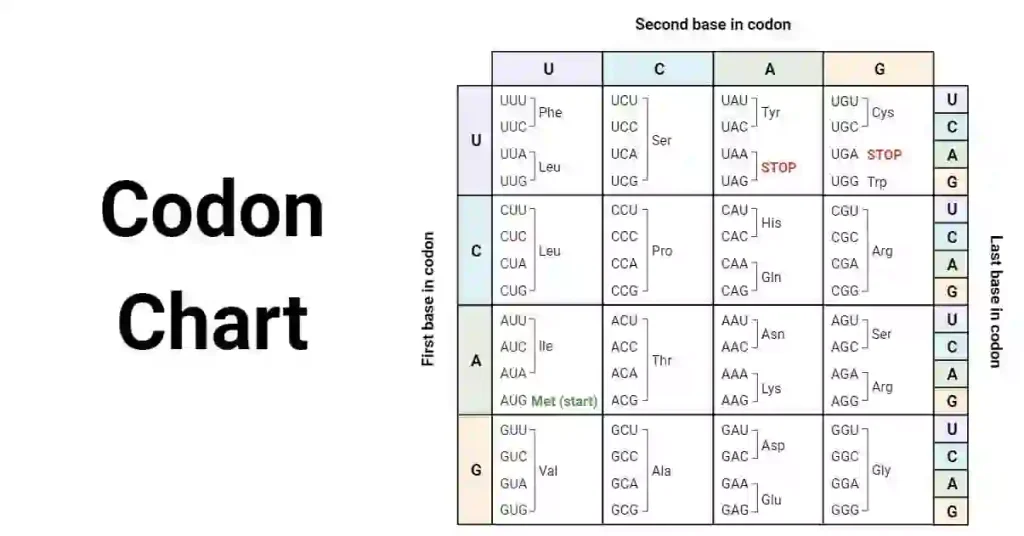
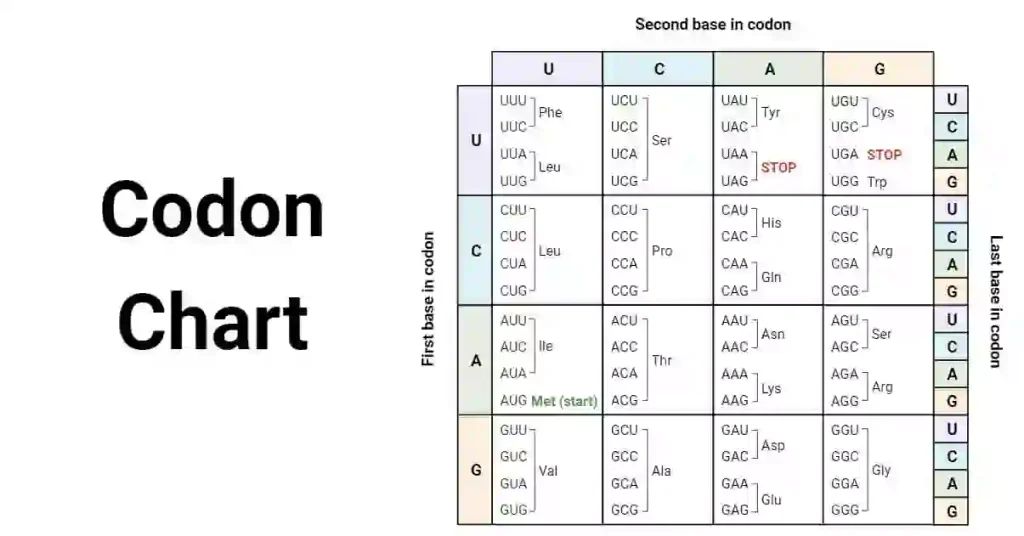
The codon chart outlines the various codon combinations and their corresponding amino acids, showing which amino acids are synthesized based on the sequence of nucleotides. In total, there are 64 possible codons: 61 correspond to the 20 different amino acids, and the remaining three are stop codons that signal the end of protein synthesis.
As shown in the chart, the genetic code is redundant (or degenerate), meaning a single amino acid can be coded by multiple codons. For example, the codons CCU, CCC, CCA, and CCG all code for proline.
To read the chart, locate each nucleotide in order. For instance, if the first codon position contains uracil (U), the second contains adenine (A), and the third contains cytosine (C), the resulting codon, UAC, represents tyrosine.
Here is the list of the 20 amino acids, along with their three-letter and one-letter abbreviations:
| Amino Acid | Abbreviation | One-Letter Abbreviation |
| Alanine | Ala | A |
| Arginine | Arg | R |
| Asparagine | Asn | N |
| Aspartic acid | Asp | D |
| Cysteine | Cys | C |
| Glutamic acid | Glu | E |
| Glutamine | Gln | Q |
| Glycine | Gly | G |
| Histidine | His | H |
| Isoleucine | Ile | I |
| Leucine | Leu | L |
| Lysine | Lys | K |
| Methionine | Met | M |
| Phenylalanine | Phe | F |
| Proline | Pro | P |
| Serine | Ser | S |
| Threonine | Thr | T |
| Tryptophan | Trp | W |
| Tyrosine | Tyr | Y |
| Valine | Val | V |
Start Codons
– Definition: Start codons indicate the beginning of protein translation within an mRNA molecule.
– Primary Start Codon: AUG is the most common start signal for initiating translation.
– In eukaryotes, AUG codes for methionine (Met).
– In prokaryotes, AUG codes for formyl methionine (fMet).
– Mechanism: Initiation factors and tRNA recognize the AUG start codon to initiate translation.
– Alternative Codons: Non-AUG start codons are relatively rare in eukaryotes. However, prokaryotes (such as E. coli) can use alternative start codons, including GUG and UUG.
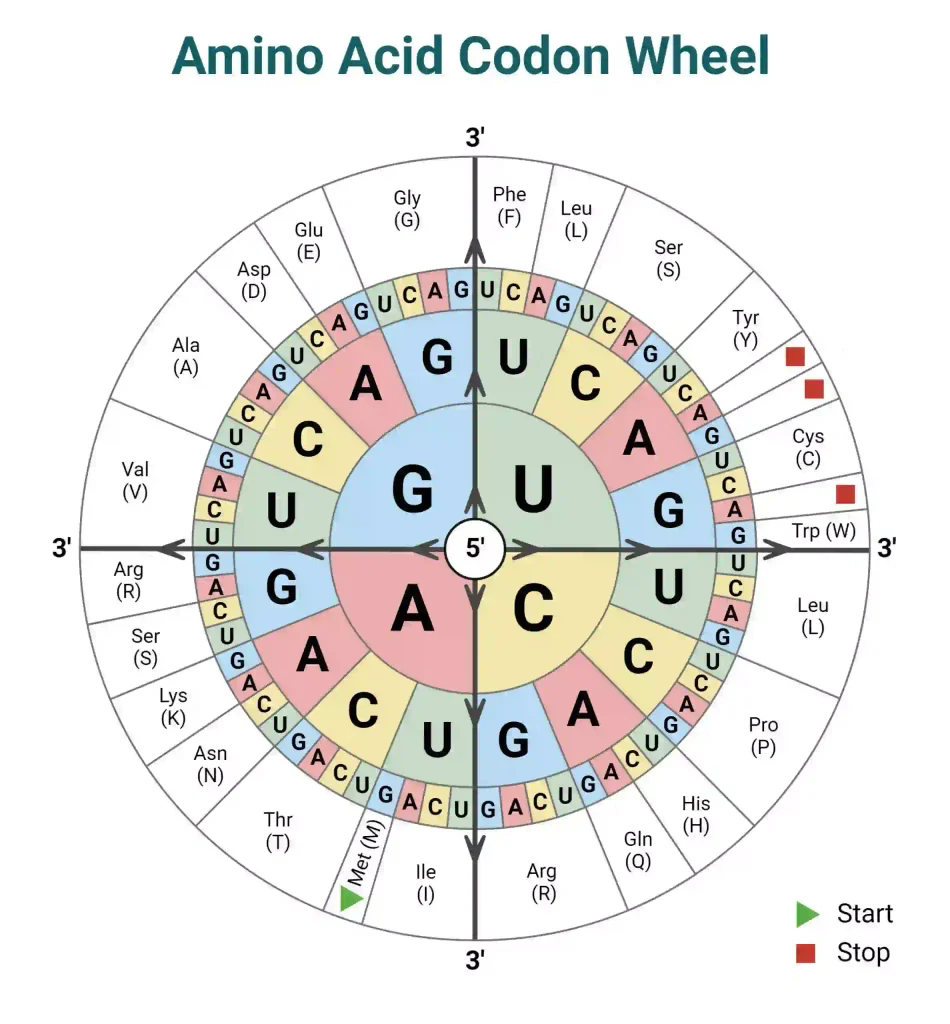
Stop Codons
– Definition: Out of the 64 total codons, three do not code for any amino acids. Known as stop, termination, or nonsense codons, they signal the end of protein synthesis during translation.
– The Three Stop Codons:
– UAG: Amber codon (the first stop codon identified)
– UAA: Ochre codon
– UGA: Opal codon
– Discovery: They were first discovered in 1965 through Sydney Brenner’s experiment on the T4 bacteriophage.
Codon Translation
Transcription: The process begins in the cell nucleus, where the enzyme RNA polymerase transcribes genetic instructions from DNA into a single-stranded messenger RNA (mRNA) molecule.
Translation: The mRNA moves to the cytoplasm, where ribosomes and transfer RNA (tRNA) read the sequence. Each RNA codon is translated into a specific amino acid, building a chain carried by tRNA molecules until a stop codon is reached.
The unique structure of tRNA ensures precise matching between the mRNA codon and its corresponding amino acid. Resembling a cloverleaf shape, the tRNA molecule consists of four double-helical stems and three single-stranded loops. The central loop, known as the anticodon loop, contains a three-nucleotide sequence called the anticodon.
Because the tRNA anticodon sequence is complementary to the mRNA codon, it enables specific and accurate interactions between the two during translation. Once transcription and translation are complete, the resulting amino acid chain undergoes modifications to become a functional protein.
References
– American Chemical Society National Historic Chemical Landmarks. Deciphering the Genetic Code. http://www.acs.org/content/acs/en/education/whatischemistry/landmarks/geneticcode.html
– Bailey, Regina. “Understanding the Genetic Code.” ThoughtCo, Aug. 29, 2020, thoughtco.com/genetic-code-373449.
– Clancy, S. & Brown, W. (2008) Translation: DNA to mRNA to Protein. Nature Education 1(1):101
– Griffiths, A. J. F., Miller, J. H., Suzuki, D. T., Lewontin, R. C., Gelbart, W. M. (2000). An introduction to genetic analysis (7th ed.). New York: W. H. Freeman.
– National Human Genome Research Institute. Codon. https://www.genome.gov/genetics-glossary/Codon
– Nature Education. Codon. https://www.nature.com/scitable/definition/codon-155/
– Nature Education. Genetic Code. https://www.nature.com/scitable/definition/genetic-code-13/
– Koonin, E. V., & Novozhilov, A. S. (2009). Origin and evolution of the genetic code: The universal enigma. IUBMB Life, 61(2), 99. https://doi.org/10.1002/iub.146
– Smith, A. (2008) Nucleic acids to amino acids: DNA specifies protein. Nature Education 1(1):126.
– Nature Education. The Information in DNA Determines Cellular Function via Translation. [link removed]
– U.S. National Library of Medicine. Translating the Code of Life and the Nobel Prize, 1962-1968 | Marshall W. Nirenberg – Profiles in Science. (nih.gov)